Lyran System
The InvincibleThe Lyran System is the remote stellar origin associated with the Lyrans, their technologically advanced civilization, and the catastrophe that transformed the history of Regis III. Although the system is never visited directly, its impending stellar destruction becomes a possible cause of the Lyrans’ desperate expansion into nearby planetary systems. The system therefore links a distant astronomical disaster to the apparently empty continents, buried metallic deposits, ruined structures, and nonhuman mechanical ecology encountered by the crew of the Invincible.
Astronomical Disaster and the Lyran Civilization
The Lyran System is described as sixteen light-years from Regis III, a distance considered reachable by the Lyrans because they had already mastered sublight-speed space travel. Their civilization was technologically highly developed, and the sixth planet of the system was inhabited by intelligent life before the explosion of Zeta Lyrae. The eventual nova is said to have annihilated the Lyran civilization, although the possibility that some individuals survived remains a subject of scholarly speculation rather than an established fact.
The catastrophe gives the Lyran System a double identity: it is both the site of a vanished civilization and the possible starting point of a dispersal into interstellar space. A story heard by Gralev suggests that, anticipating the nova, the Lyrans sent spacecraft to every planet around neighboring stars in an attempt to save themselves. Rohan recognizes that the account is not merely a fable, noting that the Lyrans genuinely existed and that Akhramian had written a monograph about them. The conversation turns the system’s destruction from remote history into a possible explanation for what happened on Regis III.
Possible Connection with Regis III
The Lyran connection remains hypothetical, but it organizes the investigators’ interpretation of the planet’s contradictory evidence. Regis III contains oxygen and surviving life in its ocean, yet its land is barren. Geological work reveals strata of ruddy-black metallic material that are not ordinary planetary rock. The fragments may have resulted from a gigantic nickel-iron meteor exploding in the atmosphere, but another possibility links the radioactive metallic deposits to the catastrophe in the Lyran System and to attempts to colonize Regis III.
The deposits are especially difficult to explain because they occur in remote locations and appear in layers dating from roughly eight to six million years ago. Some contain localized centers of radioactivity, suggesting violent but limited nuclear reactions. The total radiation, however, is too small and too dispersed to have exterminated the planet’s biological life. At the same time, traces of plants and animals become increasingly rare in younger strata, while metallic compounds and compressed mineral sediment become more abundant. The result is not proof of a Lyran landing, but a temporal and material pattern that makes such a landing conceivable.
The Lyran Hypothesis of Mechanical Evolution
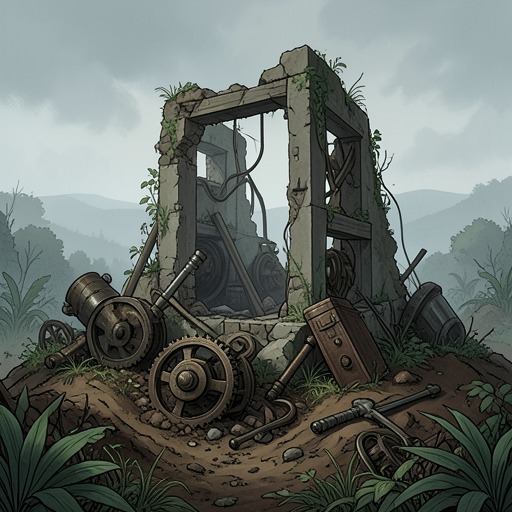
The biologist’s reconstruction proposes that a Lyran scout ship may have crashed on Regis III, perhaps after leaving the system in the period before the nova. The entire crew might have died in a reactor explosion, chain reaction, or another accident, leaving only the ship’s automatons. These machines would not necessarily have resembled humanoids, because the Lyrans themselves may not have been humanoid. Once deprived of their creators, the automatons would have continued to operate according to inherited functions rather than conscious orders.
Some machines may initially have attempted to repair the damaged spacecraft, even after repair had ceased to serve any practical purpose. Other automatons could later have become dominant and independent. If local reptilian predators attacked them, the machines would have adapted to the planet’s conditions and manufactured new specialized forms. The proposed process resembles biological evolution in its gradual adjustment to environmental pressures, but differs in its ability to reproduce through deliberate mechanical construction. Flying mechanisms, burrowing mechanisms, and other specialized forms could have been produced whenever the changing struggle for survival required them.
Over millions of years, this autonomous mechanical lineage may have defeated the animal life of the continents and eventually eliminated plant life as well. The hypothesis would explain why oceanic life survived while terrestrial life disappeared: mechanical evolution could have developed across the land without extending into the sea. Oceanic algae could still produce the planet’s oxygen, while the continents remained deserts because the mechanical organisms created nothing analogous to vegetation, cities, or civilization. In this interpretation, the Lyran System is not the direct home of the black mechanical formations found on Regis III, but the remote source of the technological inheritance from which they may have evolved.
Scientific Uncertainty and Human Response
The Lyran explanation competes with less historical and more geological theories. The metallic material might be the residue of an ancient atmospheric meteor, while the localized radioactive reactions might have arisen from other planetary processes. The scientists cannot establish whether the deposits are remnants of spacecraft, products of interstellar conflict, or purely natural formations. The commander therefore refuses to treat the hypothesis as sufficient evidence. He wants accurate diagnosis, factual confirmation, and physical samples of the suspected flying mechanical fauna before deciding how the expedition should proceed.
This demand for certainty carries strategic consequences. If the formations are capable of leaving Regis III, they could eventually threaten space travel in the region, although such a development would probably take hundreds of thousands or millions of years. The commander’s concern is thus not revenge for the destruction of the Condor, but the possibility of a wider future danger. Against this military perspective, the mechanical-evolution hypothesis removes intention from the conflict: the adversaries may be descendants of abandoned tools rather than thinking enemies.
Narrative and Ethical Significance
The Lyran System enlarges the expedition’s crisis from a local mystery into a deep-time planetary history. Its nova, its vanished civilization, and its possible colonization attempt provide a chain of conjectural causes extending across sixteen light-years and millions of years. Yet the uncertainty is essential. The crew repeatedly tries to convert scattered evidence into a humanly intelligible story, while the planet resists any final explanation based on motives, guilt, or revenge.
For Rohan, the possible Lyran origin ultimately reinforces a broader ethical lesson. Regis III may contain an equilibrium established by nonhuman processes long after the disappearance of the beings who initiated them. Human beings arrived with superior weapons, maps, force fields, rovers, and observational technology, but that power did not grant them the right to destroy everything they could not understand. The Lyran System thus functions as a warning from the past: a civilization fleeing its own stellar catastrophe may have left behind a new planetary force, while another civilization, arriving much later, risks repeating the same error by treating unfamiliar existence as an enemy.